

A dispatcher changes the vehicle for an afternoon delivery. The driver sees the change in a message, the warehouse still loads against yesterday's list, and finance later receives a charge linked to the original trip. Buying a transportation management system, or TMS, becomes worthwhile when the business needs those people to work from the same operational record.
Start by tracing one order through that disagreement. Who accepted it, who changed the vehicle, which load was released and what evidence allows the charge to be approved? A TMS evaluation should make those answers clearer. A screen full of moving vehicles is useful, but it cannot substitute for a dependable order-to-trip-to-settlement process.
TrackAsia's TMS product page describes planning and dispatch, central order and driver management, map tracking, alerts, cost reporting and connections to ERP and warehouse systems.[7] Those are relevant product areas to investigate. The practical buying decision is whether the proposed configuration can carry your own workflow—including changes, failures and reconciliation—without creating another parallel spreadsheet.
What problem should the first implementation solve?
Do not begin by trying to digitise every transport activity. Choose the operational break that causes the most repeated work. It may be dispatchers re-entering orders, drivers receiving inconsistent instructions, customer service chasing delivery updates or finance matching documents after the fact. Each starting point implies a different first integration.
Consider an illustrative distributor with one depot, contracted vehicles and deliveries to shops. Orders originate in an ERP, warehouse staff confirm what can ship, and dispatch builds trips after a daily cut-off. This example is a design scenario, not a TrackAsia customer case or a claim about achieved savings.
For that distributor, the first scope could be to receive ready-to-ship orders, assign them to trips, publish an approved plan and return execution status. Freight calculation can remain in the existing process during the pilot if it is already reliable. Trying to replace it immediately may delay the more urgent improvement: everyone knowing which instruction is current.
Write a short definition of completion. For example, an order is operationally complete only after the actual delivered quantity and exception outcome are recorded. Financial closure may occur later after charges and documents are checked. Combining these two milestones into one “done” button usually makes one department's work invisible to another.
Keep ERP, warehouse and TMS responsibilities explicit
An ERP commonly owns the commercial order and customer account; a warehouse system owns stock release and loading activity; a TMS coordinates transportation execution. These are recommended architecture boundaries to discuss, not a guarantee about any vendor's default configuration. Smaller businesses may combine several roles in one product, but ownership should still be clear.
Agree which system is allowed to edit each field. An ERP order quantity and a driver's delivered quantity represent different facts. A warehouse short shipment should not silently overwrite the commercial order. A receiving address corrected during dispatch should be returned through a defined process rather than disappearing into a local note.
Use stable identifiers at the boundaries: external order reference, shipment reference, trip reference and event reference. Do not use customer name or vehicle registration as the only matching key. Vehicles and people can change during execution; the work still needs an identity.
A practical integration needs to handle repeated messages. If the ERP resends an order after a timeout, the receiver should update or recognise the existing business record rather than create another delivery. This is an implementation requirement called idempotency: repeating the same intended operation does not produce duplicate work. Ask the supplier to demonstrate the actual import or integration behaviour with your sample.
Follow the trip through an ordinary day
Before planning, the dispatcher needs orders that are ready to travel, usable receiving points, quantities, required dates and any genuine service conditions. Missing information should appear as an exception queue. Allowing incomplete orders to enter an apparently complete plan only moves the problem to the driver.
After planning, someone approves the trip and makes it the current instruction. Record the effective version and who released it. The warehouse should load against that approved version or have an explicit reconciliation step if the load differs. A planning suggestion should not automatically become a driver instruction just because it appeared on a map.
During execution, distinguish the event time from the time the system received the event. A driver may work through a weak connection and report later. Without both times, a report can mistake delayed synchronisation for a late delivery. Ask how the offered product handles that situation; do not assume offline behaviour merely because a mobile application exists.
At completion, the dispatcher should see exceptions that still require a decision. A failed stop may need a retry, a return or a cancellation, each with a different consequence. A partial delivery should preserve both the quantity attempted and the quantity accepted. The point is to support the next action, not merely collect a red status indicator.
Ask for a demonstration that can fail usefully
Give the vendor a small prepared case rather than watching only a standard presentation. Include two normal orders, one changed address, one partial delivery and one rescheduled customer. The exact order count is illustrative; the important part is that the scenario crosses departments.
Ask the demonstrator to change a vehicle after a trip has been released. Check what the driver, warehouse and customer-service user see. Then resend the same order reference and observe whether the integration creates a duplicate. Finally, record a failed delivery and show how it becomes a controlled next-day task rather than an unresolved comment.
TrackAsia's product FAQ describes driver and customer mobile applications, actual timestamps at pickup or delivery points, and centralised handling of costs and documents.[7] Use these statements to form demonstration questions. Verify the specific user roles, document formats, event capture and integration scope needed by your project before treating them as acceptance commitments.
A useful demo reveals limitations. If a manual approval or custom integration is required, capture that in the scope. A clear boundary is easier to budget and operate than an assurance that every process is automatically supported.
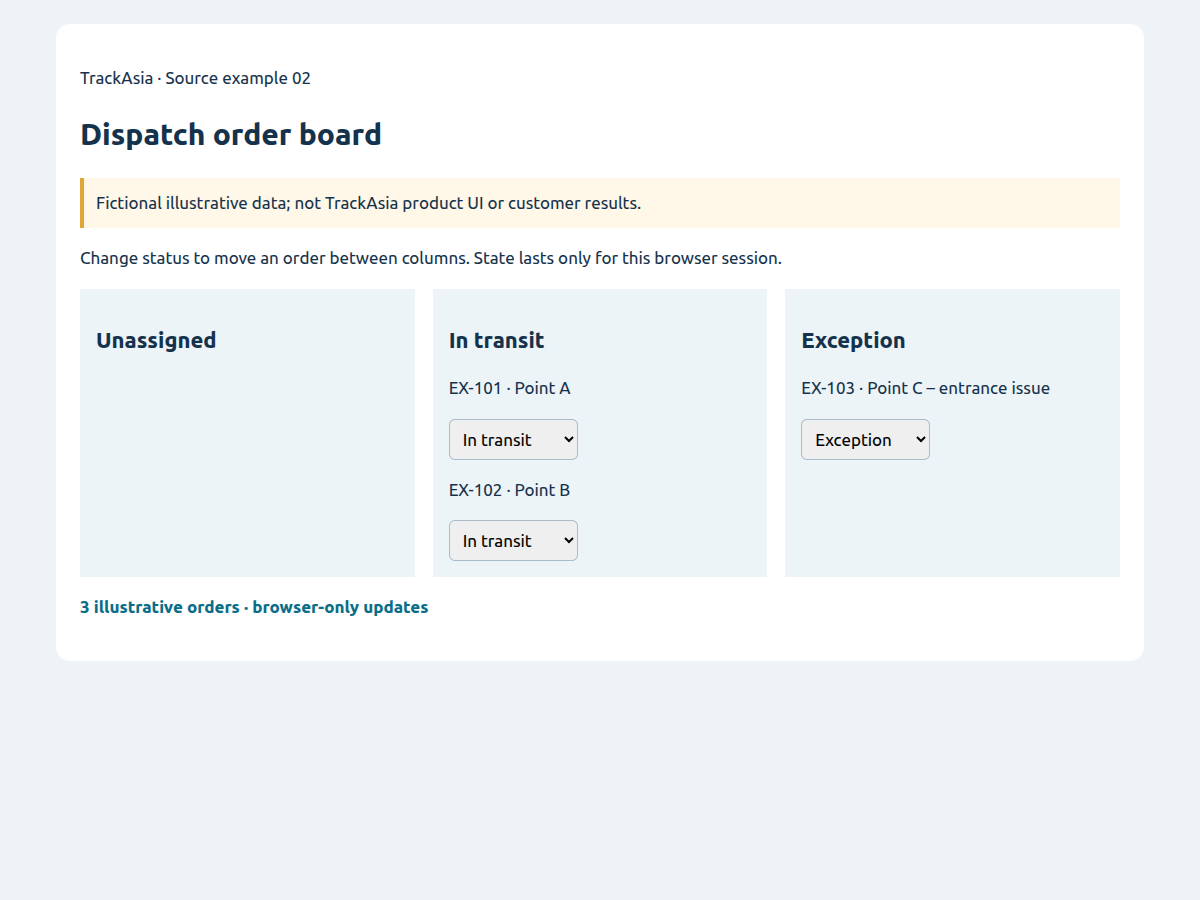
Try the source: Dispatch order board
Move three illustrative orders between dispatch, transit and exception columns.
Illustrative data and assumptions; not TrackAsia product UI, customer results or a quote.
Unzip, run python3 -m http.server 8080 in the extracted folder, then open http://localhost:8080/index-en.html. Vietnamese and English READMEs are included; no npm or build step is needed.
Tracking requires an explainable source of truth
Map tracking can answer where a device last reported, while an order event answers what happened to a shipment. Those are related but different observations. A vehicle near a shop does not prove that goods were received; a delivery confirmation does not mean a continuous location feed was available.
Define the tracking source for each fleet segment. A company-owned vehicle may have a different data source from a subcontractor's driver phone. Ask about freshness, device availability, permission requirements and what users see when data becomes old. These are evaluation requirements, not claims about built-in TrackAsia settings.
The interface should make stale information recognisable. Customer service needs enough context to avoid telling a customer that a vehicle is approaching based on an old position. Reports should likewise avoid interpreting missing telemetry as proof of inactivity without checking the data source.
Protect access to driver and customer information according to role. Dispatch may need detailed location to resolve a trip; a financial user may need only the event and supporting evidence. Set retention and export rules deliberately, especially when data is copied into spreadsheets outside the application's normal access controls.
Costs belong in the same conversation as scope
Request a quotation broken down into software access, configuration, integration, data preparation, training and any tracking connectivity or devices needed. These are cost categories to ask about, not a statement that each must be billed separately. Confirm which items are included and what triggers later charges.
Integration costs depend on more than the number of endpoints. Historical data quality, order-change rules, duplicate handling, document exchange and recovery after outages all affect effort. A direct connection that works only on the happy path can cost more to support than a slightly broader integration with clear error handling.
Ask how the current commercial arrangement counts users, vehicles, orders or other applicable units. Do not rely on a copied price table or infer one product's allowance from another TrackAsia API service. Confirm current terms in the proposal, including support, environments, exports and treatment of later changes.
Include internal effort. Dispatchers must explain exceptions, warehouse staff must agree cut-off rules, and finance must define required evidence. These tasks do not disappear because software is packaged. A realistic budget makes them visible before they become a reason the pilot stalls.
Run a pilot that produces a decision
Choose a depot or route group with ordinary variability, not only the easiest customers. Keep a comparable baseline from the existing process. Record planning effort, assignment changes, unresolved orders and the proportion of completed work with sufficient documents. These are proposed evaluation measures, not achieved TrackAsia outcomes.
Separate speed from quality. A plan created quickly is not helpful if warehouse staff then spend an hour resolving mismatched loads. A completed trip count is incomplete evidence if exceptions are carried into an untracked spreadsheet. Review the entire handoff, not one department's screen.
At the end of each pilot day, reconcile order count, assigned count, delivered or failed count and remaining work. The numbers should account for every order without double-counting a retry. Investigate discrepancies before importing a larger area, because scale amplifies ambiguous record ownership.
Agree a go-live decision in advance: which failures block release, which can be handled manually and who approves the temporary workaround. Also rehearse a connectivity interruption. Preserve the last approved work list and define how delayed events will be reconciled when service returns. Test the offered solution rather than assuming a particular offline mode.
When is custom API development the better fit?
If your business already has dependable order management, driver instructions and reconciliation, the missing component may be address search, a road-time matrix or route optimisation. TrackAsia documents those as separate API services.[1] Adding a focused location capability can be proportionate when replacing the operating platform would create unnecessary disruption.
The trade-off is ownership. A development team using APIs still has to build screens, permissions, retries, status history, release controls and support tools. A solver returning a route does not provide all of those. Compare total work and ongoing responsibility, not only subscription against request price.
Choose the TMS path when the operating workflow is the gap and the demonstrated product fits it. Choose a targeted API integration when your existing workflow is sound and the location calculation is the missing part. In either case, send TrackAsia an anonymised day of orders, your system boundaries, required exceptions and acceptance measures. That turns “we need transport software” into a proposal that both technical and operating teams can evaluate.